Root Chakra: The Complete Guide
Updated April 2026
The root chakra — Muladhara — is the first of the seven primary chakras. It sits at the base of the spine and governs the most fundamental human experience: feeling safe in your own body and in the world. When it's balanced, you feel grounded. When it's blocked, even ordinary life feels like too much.
This is the complete guide: the science, the symptoms, the traditional practices, and what modern research says actually works.
I Am Grounded.
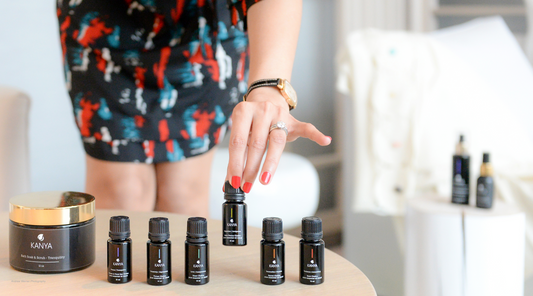
Kanya's Root Chakra formulation (Vetiver, Cedarwood, Cypriol, Ylang-Ylang) is the aromatherapy companion to every practice in this guide.
Explore the Root Chakra Collection →What the root chakra does
Muladhara (from the Sanskrit mula, "root," and adhara, "base") is associated with:
- Survival and security — food, shelter, safety
- Physical grounding — feet on the earth, body at rest
- Tribe and belonging — family, home, community
- Stability of identity — knowing who you are at a foundational level
Traditionally it corresponds to the color red, the element earth, the mantra LAM, and the adrenal glands in the endocrine system. The adrenals regulate stress, immunity, and metabolism — the biological essentials for survival — which mirrors the chakra's function with striking precision.
Signs the root chakra is out of balance
Physical symptoms of a blocked root:
- Lower back pain, hip pain, or tension in the legs and feet
- Fatigue, especially in the morning
- Reproductive or adrenal imbalances
- Digestive issues that seem stress-linked
Emotional symptoms:
- Chronic anxiety or a sense of "ungroundedness"
- Financial stress or obsessive thinking about security
- Feeling disconnected from your body
- Trouble making basic decisions
Signs the root is overactive (less discussed, but real):
- Hoarding or excessive attachment to possessions
- Resistance to change, even positive change
- A survival-focused mindset when survival isn't actually at stake
What the science says
The root chakra maps onto the adrenal glands and the parasympathetic nervous system. When either is dysregulated — which is increasingly common in high-stress modern life — the experience we call "root chakra imbalance" shows up.
Practices that calm the parasympathetic nervous system (slow breathing, grounding techniques, massage) have measurable effects on cortisol levels and inflammatory markers. A 2020 University of Konstanz study showed that even ten minutes of gentle massage activates the parasympathetic system measurably.
Six practices that restore the root
1. Walk barefoot on earth
The simplest and most direct. Ten minutes a day of skin-to-ground contact — grass, sand, dirt. Studies on "grounding" or "earthing" have shown measurable effects on inflammation and sleep quality. You don't need to believe in it; just do it.
2. Eat root vegetables
This is traditional advice that happens to line up with modern nutrition. Root vegetables — beets, carrots, sweet potatoes, turnips — are rich in minerals and complex carbohydrates that support stable energy and adrenal function.
3. Yoga for the lower body
Mountain pose (Tadasana), child's pose, garland pose, and any standing pose that emphasizes the feet pressing into the ground. Fifteen minutes, most days of the week.
4. Breathwork
Slow, deep belly breathing activates the parasympathetic nervous system. Four seconds in, six seconds out, for five minutes. The longer exhale is the key — it's what signals to the body that the threat is over.
5. Root-balancing crystals
Black tourmaline, hematite, red jasper, garnet, smoky quartz, and obsidian are the traditional stones. Carry one, wear one, or place one by your bed. Rituals with crystals work best when consistent.
6. Aromatherapy
Earthy, woody oils are the root chakra's aromatic family. Vetiver is the most powerful — its roots grow several feet into the soil, and the oil carries something of that anchoring quality. Cedarwood evokes forest. Cypriol, from a grass native to India, has been used for centuries to balance restless emotion.
Kanya's Root Chakra formulation layers these three with Ylang-Ylang for softness. The same formulation runs through every product form — body oil, essential oil blend, roll-on. Apply to pulse points, the soles of the feet, or diffuse.
A daily practice
If you want the simplest possible routine: ten minutes of slow breathing in the morning, a few drops of a root chakra blend on the wrists, and ten minutes walking barefoot in the afternoon. Three weeks of this is enough to notice a change.
Consistency matters more than intensity. A five-minute ritual done daily will shift the nervous system faster than an hour-long session done once a week.
Continue reading
- Essential Oils for Each of Your Chakras
- The Science of the 7 Chakras
- How to Balance Your Chakras with a Ritual Bath
Which chakra is calling you?
Take the 60-second Intention Quiz — a few questions that match you to the chakra blend made for how you want to feel.
Find Your Intention →