9 Body Oil Myths — Debunked
Updated April 2026
People have been using body oils as skincare for at least three thousand years. Cleopatra swore by them. So did the physicians of ancient India. And yet, a surprising number of myths still surround them today.
Here are nine of the most common, debunked with science rather than marketing.

Sampler before commitment.
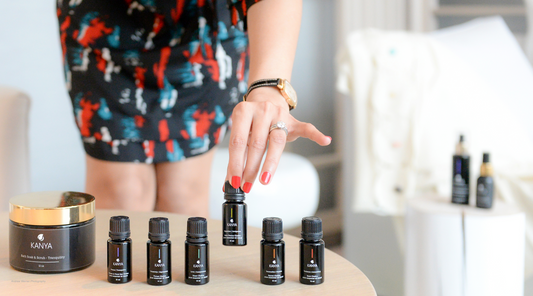
Not ready for a full bottle? The Trial Pack has all six Kanya chakra body oils in travel sizes. Great way to test absorption, scent, and fit.
Try All Six — $38 →1. "They're greasy and don't absorb into the skin"
This is the most common misconception — and the most misleading. Not every oil is thick or pore-clogging. Many feel light and are absorbed quickly. They're called non-comedogenic.
In 1989, dermatologist James Fulton developed a comedogenic rating scale from 0 to 5 — measuring how likely an oil is to clog pores. Rosehip rates a 1. Sunflower seed rates 0. Safflower rates 0. These are the oils a well-formulated body oil uses — often layered together to create a blend that feels luxurious without feeling heavy.
The second factor is timing. Body oils absorb best when your skin is still damp from a shower. The oil locks in water while being drawn into skin that's already open to receiving it.
2. "They'll stain my clothes and sheets"
Cheap, heavy oils can leave stains. A well-blended body oil is formulated to seep into the skin, not sit on top of it. Wait two minutes after applying before getting dressed, and you're fine.
Every Kanya body oil is built on a base of Maracuja, Meadowfoam Seed, Moringa, Pumpkin Seed, Rosehip, Safflower, and Vitamin E — deliberately chosen for low comedogenicity and quick absorption. The same formulations are used in Miraval's and Four Seasons' spa treatments, where guests walk out in white robes without a trace.
3. "Oils have a peculiar smell"
Cooking oils, yes. Body oils, no. A good body oil is formulated like fine fragrance — layered with essential oils chosen for both their scent profile and their therapeutic effect. And aroma isn't decorative: a 2010 study from Thailand measured the effect of jasmine oil on the brain and found that inhaling it measurably improved mood and activated the nervous system. Scent is part of the skincare.
4. "I use lotions — my body won't tolerate oils"
Lotions are essentially oils combined with water, emulsifiers, preservatives, and often fragrance additives. If you tolerate lotion, you almost certainly tolerate oil. Many people add a few drops of oil to their existing moisturizer for extra hydration.
5. "I don't have time for body oil"
Applying body oil takes about 60 seconds. There's no elaborate process — warm it in your palms, press into your skin, go. If you have time for moisturizer, you have time for oil.
6. "Essential oils and body oils are the same"
They aren't. Essential oils are highly concentrated plant extracts — from leaves, flowers, stems, or bark. They're intended for diffusers, baths, or topical use only when diluted. Used undiluted on skin, some essential oils cause irritation.
Body oils are carrier oils (jojoba, sweet almond, rosehip, etc.) blended with small amounts of essential oils — safe to apply directly to skin, and formulated specifically to nourish while delivering the aromatherapy benefits.
7. "Body oils are only for spas"
Turn your home into one. The practice of self-oiling before a bath is an ancient Indian ritual called Abhyanga — used for centuries to support circulation, calm the nervous system, and deepen connection with the body. Dr. Tiffany Field, director of the Touch Research Institute at the University of Miami, has spent decades studying touch therapy and her research suggests that self-massage can be just as effective as massage from a therapist. Your hands, some warm oil, ten minutes.
8. "I'm too macho for body oils"
Men's skin is actually thicker than women's — which means it benefits even more from deeply hydrating oils. Collagen production drops sharply with age in both men and women; using a quality body oil regularly is one of the simplest ways to support skin health. Scent and formulation aren't gendered. Results aren't either.
9. "Body oils can't be used on the face"
They can. Most well-formulated body oils are safe for the face, as long as you wash and pat dry first. If you're sensitive or acne-prone, start with a non-comedogenic blend (rosehip, squalane, jojoba) and patch test. If it agrees with you, a single good oil can replace multiple facial products.
The truth about body oils
Oils, like people, each have their own personality. When you match the right oil to your skin — and when it's formulated with intention — the result is more than moisture. It's a ritual that connects you to your body.
That's the approach behind every Kanya formulation. Six chakra-aligned body oils, each built on the same base of cold-pressed, non-comedogenic skincare oils, layered with a different essential oil blend for a different intention. The same intentional aromatherapy trusted by Miraval, Equinox Hotels & Clubs, Four Seasons, and Fairmont — now for your home.
Explore the full Body Oil collection →
Continue reading
- 11 Symptoms of Your Heart Chakra Opening
- Essential Oils for Each of Your Chakras
- How to Balance Your Chakras with a Ritual Bath
Which blend is yours?
Take the 60-second Intention Quiz — a few questions that match you to the chakra blend made for how you want to feel.
Find Your Intention →Reference
- Hongratanaworakit T. Stimulating effect of aromatherapy massage with jasmine oil. Nat Prod Commun. 2010;5(1):157-62.
- Fulton JE. Comedogenicity and irritancy of commonly used ingredients in skin care products. J Soc Cosmet Chem, 1989.