The Science of the 7 Chakras
Updated April 2026
The 7 chakras have been mapped by human experience for several thousand years. They predate peer-reviewed journals, MRI machines, and the word "neuroscience" itself. And yet — remarkably — modern science keeps finding their echoes.
Here's what the research actually says about the chakra system, the endocrine glands it mirrors, and the practices that bring the whole framework into daily life.

The easiest way in.
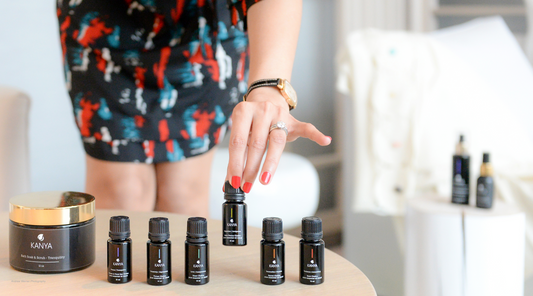
Our Trial Pack has all six Kanya chakra blends in travel sizes — the practical companion to the ideas in this article.
Try All Six — $38 →What a chakra actually is
Chakra means "spinning wheel" in Sanskrit. The traditional texts describe 114 of them throughout the body, each connected by nadis — channels that carry energy (sometimes compared to nerves or meridians). Out of the 114, seven are considered primary: the root, sacral, solar plexus, heart, throat, third eye, and crown.
You won't find these chakras in a CT scan. Think of them as a map of how prana — life energy — moves through you. The laws of physics tell us rotational objects carry internal and kinetic energy. Assuming chakras behave similarly, a reasonable question arises: why can't we feel them spinning?
Because energy, by itself, is rarely visible. It manifests through a secondary object. You don't see gravity, but you see the apple fall. You don't see a blocked root chakra, but you feel insecurity — sometimes accompanied by lower back pain or reproductive issues.
The physiological echo
You won't find the word "chakra" in a medical textbook. But the resemblance to several biological systems is striking.
The late neuroscientist Candace Pert — who coined the term "mind-body" — discovered opiate receptors in 1978 and identified them as nodal clusters where body and mind communicate through neurotransmitters. Her finding: these clusters sit exactly where the chakras are said to be. In an interview with Life Positive, Pert — often called the "Mother of Psychoneuroimmunology" — confirmed it: "The peptides and receptors — the physical correlates of emotions — are clustered at the chakra points."
The chakras also map to the endocrine glands with uncanny precision:
- Crown — Pineal gland
- Third Eye — Pituitary gland
- Throat — Thyroid gland
- Heart — Thymus gland
- Solar Plexus — Pancreas
- Sacral — Reproductive organs
- Root — Adrenal glands
Not only do the locations match — so do the functions. The adrenal gland regulates immunity, metabolism, and stress response — the essentials for survival. That's exactly what the root chakra governs: survival and security.
What the research says about activation
If chakras operate interchangeably with the endocrine and nervous systems, they can get blocked — just like any gland or nerve pathway. Here's the science behind five of the most common practices for bringing them back into flow.
Yoga. A yoga institute study measured the impact of asanas on adolescents' endocrine systems and found that yogic postures help the endocrine and nervous systems operate at optimal levels.
Meditation. Research from Melbourne's Victoria University and Belfast's Queen University found that meditation measurably improves endocrine function — beyond the well-known stress and heart-rate reductions.
Sound. Researchers at Tokyo's Juntendo University demonstrated that different music frequencies produce different endocrine responses — particularly in oxytocin and cortisol. Music at 528 Hz, sometimes called "healing music," reduced stress measurably even in brief exposure.
Massage. A 2020 study from the University of Konstanz, published in Scientific Reports, found that ten minutes of relaxing massage activates the parasympathetic nervous system — reducing both psychological and physiological stress.
Aromatherapy. A global review in the Journal of Nursing Research found that aromatherapy improved postpartum women's experience across multiple measures: anxiety, depression, fatigue, mood, pain recovery, sleep quality. No side effects reported.
Where the science gets personal
Aromatherapy is where the chakra framework gets practical. Specific botanical aromas resonate with specific chakras. Each Kanya blend is built around this — formulated like fine fragrance, layered with top, heart, and base notes that evolve on your skin over hours.
Six chakra formulations, one per intention — I Am Grounded (Root), I Am Passionate (Sacral), I Am Confident (Solar Plexus), I Am Joyful (Heart), I Am Open (Throat), and I Am Peace (combining Crown and Third Eye). Whether you reach for the body oil, the pure essential oil blend, or a roll-on, the formulation is the same. The question is which intention.
This is the same intentional aromatherapy trusted by Miraval, Equinox Hotels & Clubs, Four Seasons, and Fairmont.
Continue reading
- 11 Symptoms of Your Heart Chakra Opening
- Essential Oils for Each of Your Chakras
- How to Balance Your Chakras with a Ritual Bath
Which chakra is calling you?
Take the 60-second Intention Quiz — a few questions that match you to the chakra blend made for how you want to feel.
Find Your Intention →References
- Azeemi ST, Raza SM. A critical analysis of chromotherapy and its scientific evolution. Evid Based Complement Alternat Med. 2005;2(4):481-488.
- Kay AJ. Healing and the Chakra System. International Journal of Complementary & Alternative Medicine. 2016;4(5):00136.
- Pert C. Molecules of Emotion: Why You Feel the Way You Feel. Scribner, 1997.