Frankincense: 5 Real Benefits and 5 Myths
Updated April 2026
Frankincense has been used for at least 5,000 years — in Egyptian funerary rites, in temples from Israel to India, in Roman medicine, in modern aromatherapy. Few oils have that kind of continuity. Few are as misunderstood, either.
Here's what frankincense actually does, and what it doesn't.
I Am Peace.
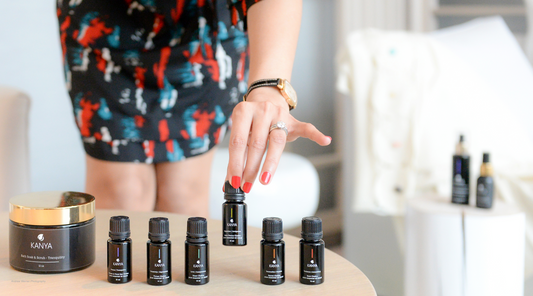
Kanya's Crown & Third Eye blend is built around frankincense — paired with Holy Basil, Lavender, and Myrrh.
Explore the Crown & Third Eye Collection →5 real benefits
1. It supports the nervous system
Frankincense slows breathing and deepens attention — which is why it's been used for meditation across so many traditions. The compound responsible (incensole acetate) has been shown to activate the brain's anti-anxiety pathways.
2. It supports skin regeneration
Frankincense is one of the most studied essential oils for skin renewal — useful for fine lines, scars, and uneven tone. Used in well-formulated body oils, it supports cellular turnover without harshness.
3. It has antimicrobial properties
Modern research has confirmed what ancient practitioners suspected: frankincense kills certain bacteria and fungi. This is why it was used in temples (clean ritual space) and in early medicine.
4. It supports immune function
Boswellic acids — the active compounds in frankincense resin — have been studied for their anti-inflammatory and immune-modulating effects. Topical and aromatic use both contribute, though oral use of resin is the most studied.
5. It deepens spiritual practice
Hard to quantify, but consistent across traditions. Whether you frame it as effect on the limbic system, on breath, or on something less measurable — frankincense has been used to mark sacred moments for millennia. It does something.
5 myths to retire
Myth 1: "All frankincense is the same."
There are several species — Boswellia carterii, sacra, frereana, serrata. Each has slightly different chemistry and aromatic profile. Cheap "frankincense" is often a blend or a less-active species. Look for brands that specify the species.
Myth 2: "It cures cancer."
This claim circulates online and isn't supported by clinical evidence in humans. Some lab studies show interesting cellular effects of boswellic acids, but extrapolating from petri dishes to cancer treatment is a major leap. Frankincense is supportive, not curative.
Myth 3: "You can apply it directly to skin."
Like all essential oils, frankincense should be diluted before topical use. Pre-formulated body oils (like Kanya's) skip this step — they're already diluted in carrier oil.
Myth 4: "It works instantly."
Aromatherapy effects are real but cumulative. You'll notice some shift after a single use, but the deeper benefits — skin renewal, nervous system regulation — show up over weeks of consistent use.
Myth 5: "It's an alternative to medical care."
It's a complement, not a replacement. Frankincense can support the immune system, calm the nervous system, and improve skin — but if you have a serious condition, it works alongside medical care, not instead of it.
How Kanya uses it
Frankincense is the heart of our Crown & Third Eye formulation (I Am Peace) — paired with Myrrh, Holy Basil, and Lavender. The same formulation runs through every product form: body oil, pure essential oil blend, and roll-on.
It's the blend for the end of the day, the beginning of a meditation, or any moment you choose to turn inward.
Continue reading
- Essential Oils for Each of Your Chakras
- Essential Oils for the Crown Chakra
- The Science of the 7 Chakras
Which chakra is calling you?
Take the 60-second Intention Quiz — a few questions that match you to the chakra blend made for how you want to feel.
Find Your Intention →